Product Overview
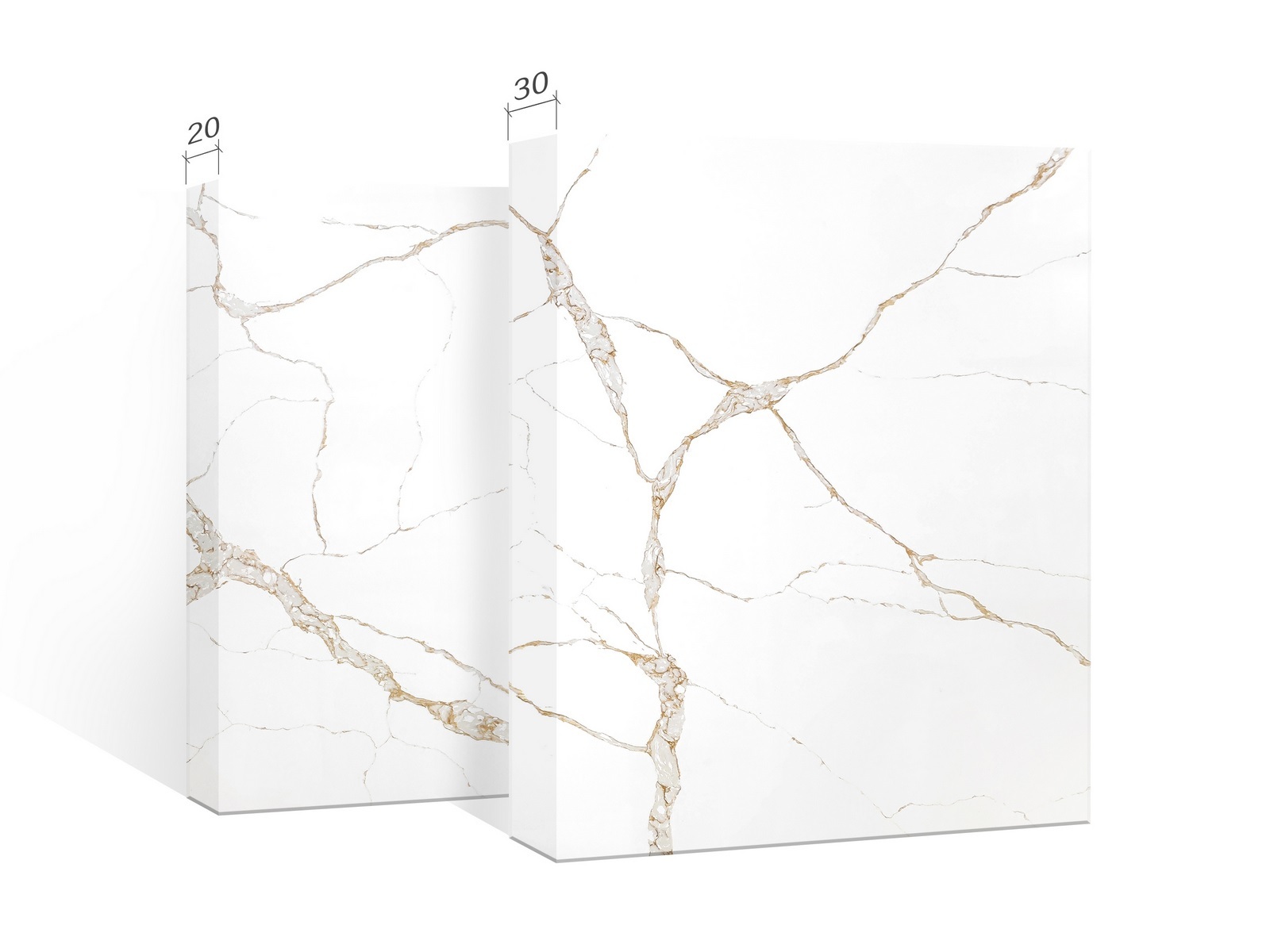
Calacatta Bellezza Gold quartz is an engineered Calacatta quartz stone with gold and beige veining running through a cool white ground, produced in a super jumbo slab. At that size a single slab carries a whole kitchen island, a hotel reception counter or a long splashback run, so the layout is decided by the room rather than by where the next joint has to fall.
The veining is broad and directional. Warm gold lines cross the white field with softer beige shading between them, so the slab reads as stone from across a room and still has detail close up. In a bright open-plan kitchen, gold vein Calacatta quartz for residential kitchen countertop use gives the island a focal point without competing with the joinery; it sits comfortably with warm oak, walnut, brass hardware and matte black frames, and just as easily against an all-white scheme.
We produce the slab in two thicknesses. Polished is the standard finish and gives the sharpest reflection; matt (honed) and leather finishes are available where a softer, less glossy surface suits the design.
Most enquiries for this colour come from the Gulf, and the material suits how kitchens are used there. Large unbroken surfaces are quick to wipe, the pale ground keeps a room bright when daylight is strong, and there are no open joints for dust to settle into. Many designers cut the splashback from the same slab as the countertop, so the vein carries on from the worktop up the wall.
Production Process
- Raw material inspection. Quartz aggregate, sand and powder are inspected and classified on arrival, before anything is weighed out.
- Feeding and mixing. Natural quartz aggregates, sands and powder at 92% to 93% are blended with unsaturated polymer resin, pigment, coupling agent and other materials at a precise ratio, then poured into the mixing machine.
- Forming. The mix goes into moulds of 3050 × 1450 mm or 3250 × 1650 mm and is consolidated under vacuum with vibration, high temperature and pressure in the kiln until it sets into a solid slab.
- Grinding and polishing. Each slab is calibrated to the ordered thickness on the calibrating machine, then water-polished for an even surface.
- Edge cutting. The rough edges left by forming are clean-cut on the bridge cutting machine so the panel is square and ready to template.
- QC and packing. Surface, thickness and edges are checked against the order before the slab is packed for export.
Quality Control & Documentation
- Full-process inspection. Raw material, production, calibration, polishing and packing are each checked, so a fault is caught at the step that caused it rather than at the container door.
- Every slab is checked before packing. Surface, thickness, edge squareness and pattern are reviewed on each super jumbo quartz slab, and any panel that misses the agreed finish goes back for rework.
- Finish standards agreed up front. Polish level, edge straightness and flatness are confirmed against the order, so what lands on site is what was approved.
- Third-party inspection is welcome. Independent inspectors and your own QC team can attend the factory for a production review and a pre-shipment check.
- Documentation for project handover. Tell us at enquiry stage which test reports and declarations your client requires — the paperwork a prefabricated quartz countertop supplier is normally asked for at tender stage — and we will confirm what can be supplied with the order.
- Traceable bundles. Slabs are packed by bundle with their reference, and custom labels or lot numbers can be applied so a later reorder can be matched back to the same production run.
Technical Data & Test Reports
| Property | Why it matters on your project | How the figure is reported |
|---|
| Water absorption | Whether a spill sits on the surface or is drawn into it — the number a specifier asks for on kitchen worktops and wet areas. | Measured on a sample taken from the production lot and given as a percentage; the report names the test method and the laboratory that carried it out, so it can be filed with the project. |
| Mohs hardness | How the polish stands up to abrasion from chopping, crockery and daily wiping, quoted on the 1–10 scratch scale. | Measured by scratch test on the lot sample and issued with the same report — ask for it when your specification calls for a hardness figure rather than a description. |
| Flexural strength | The bending load a panel carries before it fails, which is what governs a cantilevered bar top, a long overhang or an unsupported waterfall leg. | Reported in MPa for the lot with the test standard and laboratory named, so your fabricator can check the design against a real value. |
| Compressive strength | The load the material takes in direct compression — relevant to heavy tops on slim cabinets and counters that people stand on. | Reported in MPa with the method stated on the test sheet issued for the production run. |
| Bulk density | Confirms the slab is a compact engineered stone rather than a lighter, more resin-rich mix. | Given as a measured figure on the lot report; it can be cross-checked against the thickness and weight of your own shipment. |
| Thickness tolerance | Keeps every panel in a mixed order consistent, and matters where the edge is left as a single thickness rather than built up. | Confirmed against the approved order as a permitted range, measured on the finished panel before packing. |
| Slab flatness | Decides how easily the panel beds down on cabinets and how tightly the mitre closes on a waterfall leg. | Checked on the calibrated slab before export, with the tolerance agreed against your order. |
| Finish and gloss level | Polished, matt and leather read very differently under a downlight, and the level has to match the panel that was approved. | Agreed from the approved panel before production, then compared with that approval at final inspection. |
| Colour reference | Lets a reorder be traced back to the same look rather than to a verbal description. | Quoted as the colour name and reference for Calacatta Bellezza Gold quartz on the order and on the bundle label. |
Super Jumbo Slab Format
- Seams stay off the island. A super jumbo quartz slab covers a full island top in one piece, so the joint that usually cuts across the busiest part of the kitchen is simply not there.
- Waterfall ends from one piece. The top and the return can be cut from the same slab, keeping the vein running down the leg instead of restarting at the floor.
- Fewer joints to keep clean. Every joint is a line where dust and cooking residue collect; fewer of them means a quicker wipe-down in a hot, humid kitchen.
- Better yield per slab. Large panels let the fabricator nest sink, hob and tap cut-outs inside the offcuts, so more of the area you pay for ends up in the finished top.
- Faster site work. Fewer pieces to lift, level and glue means less time on site and less risk to finished floors.
- Smaller formats when they suit better. The same material also comes in the jumbo and standard panel sizes, in both thicknesses, for vanity tops, splashbacks and lift-sized pieces where a full super jumbo slab would be wasteful.
- Book-matching is settled at quotation stage, not on site. Where the gold veining runs broad and diagonal across the white ground of this Calacatta quartz stone, a matched pair meeting at the mitre produces a chevron; a mismatched pair shows two unrelated lines colliding at the corner of the island. That said, not every waterfall island needs a mirrored pair. If the design reads better with the vein running quietly in one direction along the worktop and down the leg, a single super jumbo quartz slab at 139" × 79" will carry the top, the leg and usually the splashback as well, which saves both a slab and a joint. Mirror the vein only where you want the pattern itself to be the feature. Decide how many panels to reserve from the island drawing rather than from the slab count on the quotation. Ask your fabricator to nest the top, both legs and the splashback on a cutting plan first; where the corners have to mirror, reserve the extra panel at the same time and keep the set together, because a slab bought later comes from another run and cannot be made to match back. Orientation is a design decision you should draw, not leave to the saw. Vein running lengthwise gives a calm horizontal band; vein running down the leg gives the mirrored, dramatic version; vein fanning from the centre of the island is a third option and needs the widest panel. Mark the chosen direction on the layout and on the back of each slab before anything is cut — the workshop cuts to the drawing, not to the sample photograph. Keep the reserved set banded together through the whole process. Dry-lay the panels in installation order, photograph the layout, number every piece, and make sure the same set stays together through cutting, edge profiling and packing; splitting it between two crates is how a matched island arrives with the legs reversed. Send us the island drawing, the waterfall leg detail and the splashback height, and we will mark up which face of which slab goes where and confirm what we can hold for the set on your production slot.
Site Handling in Hot Climates
- Store upright, in the shade. Keep slabs on an A-frame or stillage. Stacking quartz flat, or leaving it in direct sun, puts a bending load on a panel that is designed to be carried on edge. 2.
- Dry-lay and number the pieces. Lay the slabs out in installation order, check the vein flow from one panel to the next, and mark the back of every piece before anything is cut.
- Keep it out of prolonged direct sunlight. Long exposure is what warps a quartz panel and fades the colour, so balconies, outdoor kitchens and sun-facing shopfronts should be discussed with us before the order is confirmed.
- Guard against thermal shock. The resin that gives quartz its flexibility and reduces its brittleness can be damaged by a sudden change in temperature, so hot pans, baking trays and portable hobs belong on a trivet or heat mat, never directly on the surface.
- Clean with mild neutral detergent and water. Abrasive powders and strong acids dull the polish and are the usual reason a surface looks tired after a year.
Applications Across the Gulf
Kitchens take most of this material. A Dubai apartment with an open-plan island and a waterfall end is the classic case of gold vein Calacatta quartz for residential kitchen countertop use: one panel for the top, one for the leg, and the splashback cut from the same run so the gold vein travels up the wall. In a Riyadh or Jeddah villa the slab usually stretches further — the main island, a pantry counter and sometimes a dining table top, all from one production run, so the ground floor reads as a single specification rather than a set of separate purchases. Hotels and hospitality use it where a counter has to look unbroken at a distance: lobby reception desks, bar tops, breakfast buffets and guest bathroom vanities. A super jumbo quartz slab lets a hotel run the same colour through a hundred rooms without a visible break in the most photographed areas. Commercial fit-outs use it for reception counters, meeting-room tables and checkout counters, because a large panel takes the knocks of a public space and still wipes clean at the end of the day. On walls it works as a full-height splashback or a feature panel behind a hob, matched to the counter beneath it because both come from the same run.
Specifications
| Material | Engineered quartz stone |
| Colour and pattern | Calacatta Bellezza Gold — gold and beige veining on a white ground |
| Reference | No. D9296 |
| Super jumbo slab | 3530 × 2030 mm (139" × 79") |
| Jumbo slab | 3230 × 1630 mm (127" × 64") |
| Standard slab | 3030 × 1430 mm (119" × 56") |
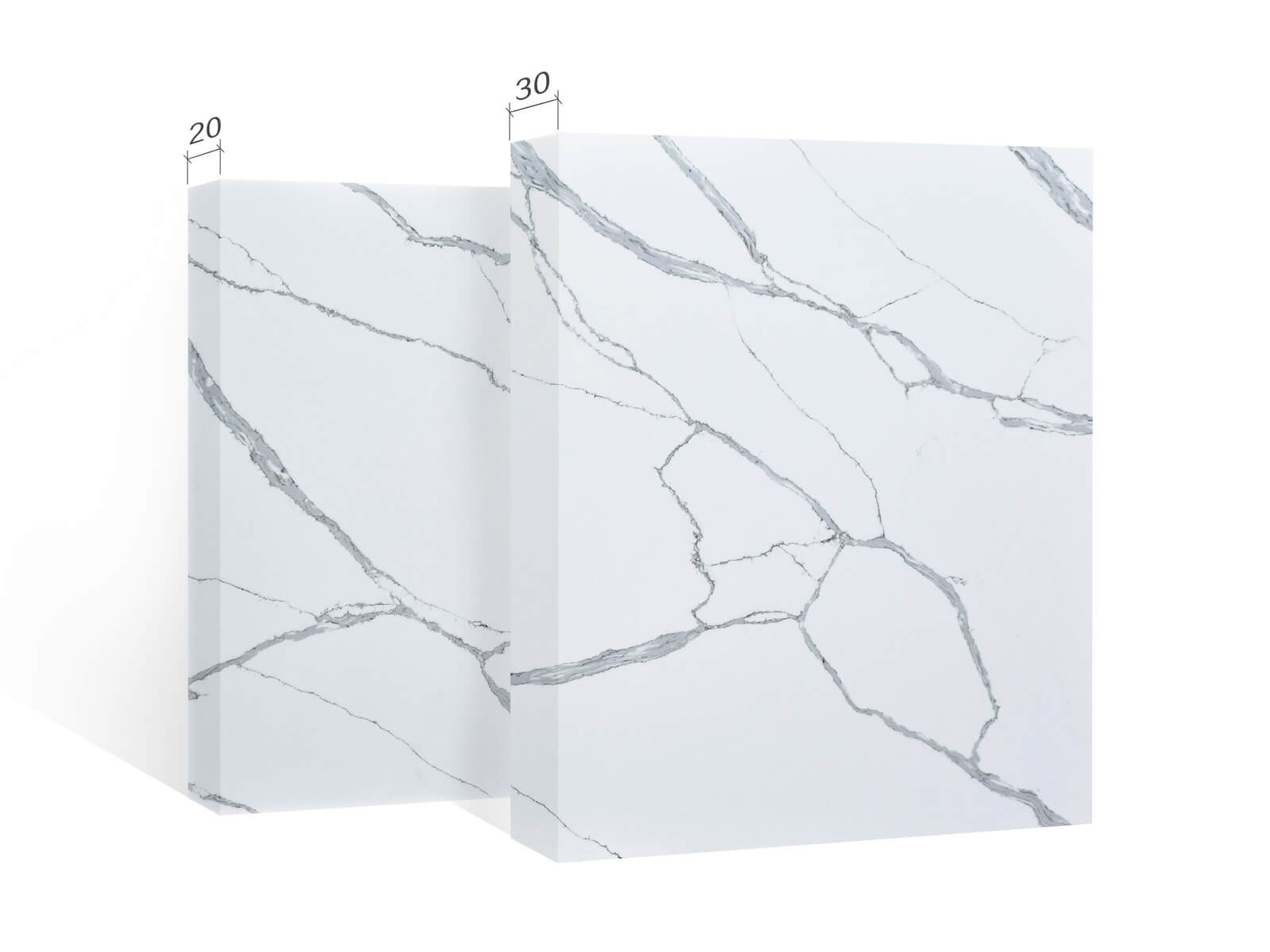
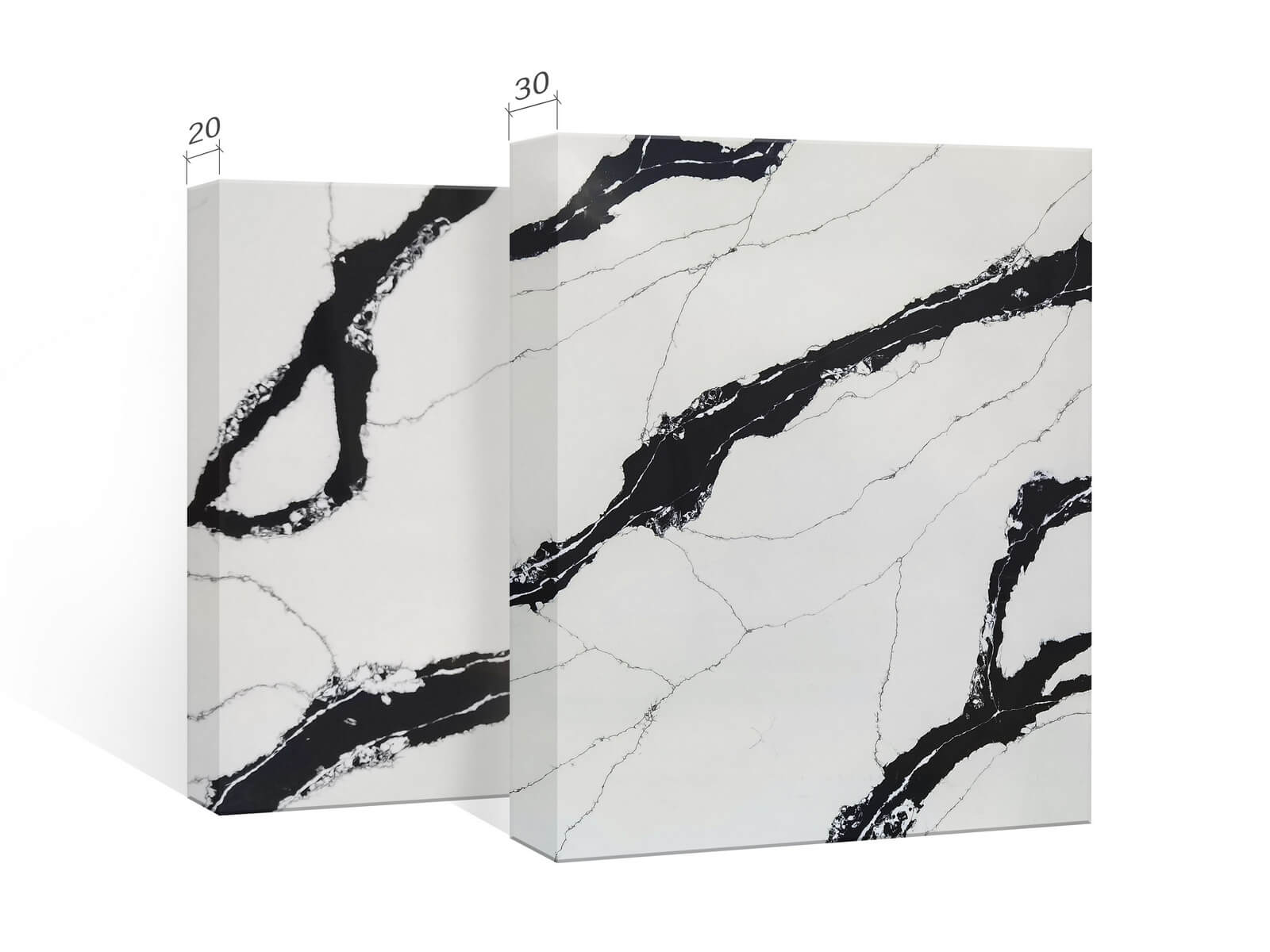
| Thickness | 20 mm and 30 mm |
| Surface finish | Polished (standard); matt / honed; leather |
| Slab edge | Straight cut; profiles fabricated to order |
| Jumbo and super jumbo production | Calacatta, Carrara, Super White and Sparkle ranges |
| Typical use | Kitchen countertops and islands, vanity tops, table tops, reception counters, wall cladding |
| Custom sizing | Slab sizes and finishes made to project requirements |
Fabrication & Custom Work
Slabs are only part of what leaves the factory. If your project needs finished pieces rather than panels, we fabricate countertops and vanity tops to your drawings: sink and hob cut-outs are made on CNC equipment, edges are profiled and polished on automatic lines, and each top is dry-assembled and checked before packing. For buyers who want one source, this is what working with a prefabricated quartz countertop supplier actually saves — the slab and the finished top come from the same production run, so the island in the main kitchen matches the vanity two rooms away without a second colour reference. Private label is straightforward. If the design calls for something other than this colour, our range covers more than a hundred engineered quartz designs, including other Calacatta quartz stone patterns alongside veined, solid and sparkle surfaces. Custom slab sizes and finishes are made to project requirements — send the panel list and we will confirm what the format allows.
Ordering & Delivery
- Lead time. Production runs ship in 15–25 days after deposit; custom sizes, finishes or fabricated tops are confirmed against the same schedule when the order is placed. - Packing. Slabs travel in strong wooden crates with foam protection, bundled and braced so they cannot move inside the container. - Container loading. A 20' GP or open-top container takes 7 bundles, with 15 slabs of 2 cm per bundle or 10 slabs of 3 cm per bundle. - Shipping to Dubai, Riyadh and beyond. Our surfaces go to projects in more than 100 countries, and regional partnerships in the Middle East coordinate delivery for Gulf sites. - Samples. Tell your sales contact which slabs you need to see and we will confirm availability and how they are sent. - Minimum quantity and payment terms. These are set per order, so confirm the current terms with your sales contact before you commit. - If a slab arrives damaged. Photograph the crate and the panel before it is moved, note it on the delivery paperwork, and send the photos to your sales contact the same day so the claim can be raised with the carrier. - What to send with your enquiry. Panel or slab sizes, thickness, finish, quantity, destination port and the date the material has to be on site. - Talk to us. Send your slab list to info@bstquartz.com and we will come back with availability, a quotation and the production slot.
Scale & Supply Capability
Bestone has been in the stone trade since 2007 and selling through our website to overseas buyers since 2012. Production is in-house, so standard runs and custom or private-label orders placed with us as a prefabricated quartz countertop supplier are handled by one team rather than passed between suppliers. We serve distributors, fabricators, contractors and designers across North America, Europe, the Middle East, Southeast Asia and Australia, and we confirm each order in writing before production starts. Send our sales team your quantities, destination and target specification, and we will tell you exactly what we can commit to.
FAQ
Is Calacatta Bellezza Gold quartz a natural marble or an engineered stone?
It is engineered quartz. Quartz aggregate is bound with resin and pigment and formed under vacuum, heat and pressure, so the veining is part of the material rather than a print on the surface. That also means it behaves differently from marble in a kitchen: the surface is non-porous, so it does not take a sealer the way a marble countertop does, and it is far less variable from one slab to the next.
Can two slabs be book-matched for a waterfall island?
Yes, and it is worth planning before you order. Reserve the slabs for an island as one set so they come from the same production run, then have your fabricator dry-lay them in installation order and mark the vein direction before cutting. Book-matching performs correctly when both panels are oriented the same way, so the gold veining continues down the waterfall leg instead of reversing direction.
How close will the delivered slab be to the sample I was shown?
Every slab is a production piece, so the pattern shifts slightly from slab to slab and from run to run — that variation is what makes the material read as stone rather than as a print. Ask for a sample cut from current production before you commit, and tell us if the project needs a particular look, so we can confirm what is available from the run being made.
Does gold vein calacatta quartz for residential kitchen countertop use resist stains and scratches?
The surface is non-porous, so spills sit on top instead of soaking in, and a mild neutral cleaner is enough for daily marks. Quartz is a hard material, but no countertop is scratch-proof — use a chopping board, avoid dragging cast-iron pans across the top, and keep strong acids and abrasive powders away from the polish.
Should I choose 20 mm or 30 mm, and does the thickness change the look?
20 mm is the usual choice for standard countertops and keeps both weight and cost down; where the design calls for a deeper edge, the fabricator builds the front up so it reads thicker. 30 mm is chosen where the edge is left fully exposed — waterfall legs, bar tops, open shelving — because the full slab thickness shows. This colour is produced in both.
Which finish suits which kind of kitchen — polished, matt or leather?
Polished reflects the most light and shows the vein most sharply, which suits bright, open-plan rooms. Matt, or honed, softens reflections and is more forgiving of fingerprints on a hard-working island. Leather gives a textured, low-sheen surface that reads warm under low lighting. The three are easiest to judge side by side on a large panel rather than a small chip, because reflection changes with the size of the surface.