Product Overview
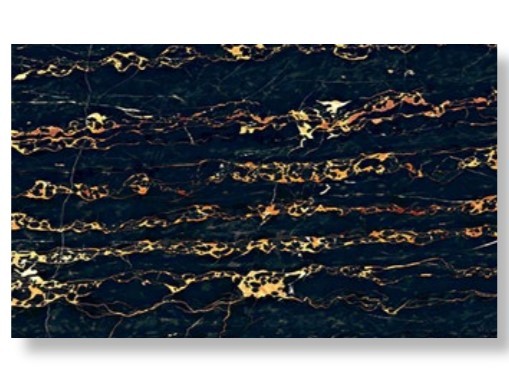
The Italian Black Goldilocks marble sheet for feature wall cladding is a natural black marble with a blue-black ground and warm gold and brown veining running through it. We buy it in block form and slice it into sheets thin enough to bend — a genuine stone face rather than a printed film, and light enough for one person to carry a full panel. Nothing about the surface is reconstructed: the veins are the stone's own, and they carry from one sheet into the next when the panels are cut in sequence. Thinness is what makes the panel useful on a feature wall. Solid marble of conventional slab thickness needs a substrate designed for the load and two people on every lift; an ultra thin marble panel is bonded to a flat, sound wall and rolled down, and the finished face still reads as solid stone to anyone standing in front of it. Because the sheet sits close to the wall instead of standing off it, it slips into rebates, behind trims and around junctions where a slab would have to be built around. On site it behaves like a heavyweight veneer. That is often the difference on a fit-out: a wall detail that looked like a stone subcontract can be handled by the same team that is already hanging doors and fitting joinery.
Colour & Veining Character
- A blue-black ground, not a flat black. The Italian Black Goldilocks marble sheet for feature wall cladding runs from deep navy to charcoal depending on the light, with gold and brown veins crossing the face. That mix of a cool ground and a warm vein is what lifts it above a plain black marble and keeps the wall moving as you walk past it.
- Strong next to warm metals and timber. Brass, bronze, walnut and blackened steel pull the gold out of the face, so a wall of this stone behind a bar or a run of joinery gains depth from the contrast rather than fighting it.
- Veins travel across a wall, not inside one panel. Cut in sequence from the same block, each ultra thin flexible marble panel picks the vein up where the previous one left it, so a long wall reads as one piece of stone instead of a set of tiles.
- Raking light changes the whole face. Under daylight the gold goes soft and the ground looks almost black; with a wall washer or a downlight close to the surface the veins brighten and the panel gains relief. Plan the lighting at the same time as the panel layout.
- No two sheets are identical. This is quarried stone, so movement, vein density and ground tone shift from block to block. Ask for photographs of the current block before you commit a full wall, and keep an offcut on file for the next phase of the project.
Manufacturing & Quality Control
- Block selection. Incoming blocks are inspected and classified before anything is cut, and a block with a fault line does not go to the saw.
- Slicing. The block is sawn into sheets on our thin-slice line.
- Sheet finishing. Each sheet is trimmed and checked for thickness and flatness, and the reverse is prepared for bonding so the panel lies down cleanly on the wall.
- Face finishing. The stone face is ground and polished to the finish agreed on your sample.
- Edge cutting. Panels are squared on the cutting line and kept in sequence, so a wall set arrives in the order it will be fixed.
- Quality control and packing. Face, edge, thickness and flatness are checked panel by panel, then the set is crated with protection between sheets and inspected again before the load is closed.
- The same site, the same discipline. As a custom flexible stone veneer exporter, we run engineered quartz lines alongside — feeding and mixing of quartz aggregate, resin and pigment, forming under vacuum and vibration, grinding and polishing, edge cutting, QC and packing — and the same quality team signs off both.
Fixing & Installation
- Check the substrate first. It needs to be flat, dry, sound and free of dust or flaking paint; fill and sand any hollows, because the sheet follows the wall and every bump shows through.
- Dry-lay the panels in the order they will go up, face out, and number the back of each one. This is the moment to check that the vein lines up across the joints, because once the adhesive is on you have minutes rather than hours.
- Mark and cut. Thin sheets score and snap with a sharp knife, and a fine-tooth blade or a diamond disc in an angle grinder handles sockets, corners and longer cuts. Try the cut on an offcut first — the blade setting matters more on stone this thin than it does on tile.
- Trial-fit every piece, including trims and openings, before any adhesive is opened.
- Apply the adhesive in a full, even bed — a contact adhesive or a suitable tile adhesive, following the adhesive maker's open time and coverage. Tell us your substrate if you are unsure which system we would use on it — as a custom flexible stone veneer exporter, we can confirm the adhesive and fixing method for your wall.
- Press the ultra thin flexible marble panel into place from the centre outwards and roll it down with a hard roller or a float, working towards the edges to push out trapped air.
- Finish the joints and edges, wipe the face with a damp cloth while any adhesive at the edges is still soft, and protect the wall from knocks for the first day.
Care & Maintenance
Natural marble is a calcium-based stone and it reacts to acid, which shapes most of the care. Wipe the face with a soft cloth and a pH-neutral cleaner, and keep vinegar, citrus sprays, descalers and anything sold as a limescale remover away from it — they etch the surface and dull the finish. A little mild washing-up liquid in warm water is enough for everyday marks on a feature wall, a vanity panel or a joinery front.
Spills are worth catching quickly. Wine, coffee, oil and anything carrying dye can leave a shadow on natural stone if it sits, so blot rather than rub, then wipe over with a damp cloth and dry the area. Grit is the other enemy: skip scouring pads, abrasive powders and gritty creams, and use a microfibre cloth, which is all a polished or honed face needs.
On joinery, dust along the edge trims as well as the face, and keep the joints dry. A joint that holds water is where a thin stone face starts to lift, so check under basins, around splashbacks and along the bottom of a wall where a mop is likely to run. Once the adhesive has cured, look the finished wall over in daylight and again under the room's own lighting, and note anything that needs attention before trims and skirtings go on. On a live site, board and tape the finished panels while other trades are still working.
Design Applications
- Full-height feature walls. A floor-to-ceiling run in a sitting room, dining room or along a stair wall: an ultra thin marble panel gives the wall a single stone face that would be slow and heavy to build in slab, and the panels are sequenced so the joints fall into the vein.
- Joinery fronts. Cabinet doors, drawer fronts, island panels and bar fronts are where the sheet earns its keep — bond it to the door carcass, trim the edge, and the door still swings on its original hinges because the stone adds only its own few millimetres.
- Ceilings and ceiling inlays. A dark marble ceiling over a dining table or a bar is workable with a thin sheet, but the fixing method is carrying the weight overhead, so run the detail past our team before you set it out.
- Countertop re-facing. Instead of stripping out a sound worktop, bond a new stone face over it; the existing top becomes the substrate and the job stays out of a skip.
- Vanity and bathroom walls. Behind a basin or along a bathroom wall, with the adhesive and sealer chosen for the exposure — tell us where the water lands and we will advise.
- Commercial and exhibition panels. Store groups specify the same Italian Black Goldilocks marble sheet for feature wall cladding across every branch, so a new opening matches the last one and the panels can be taken down and fixed again between sites.
- Repeatable detail across a project. As a custom flexible stone veneer exporter we cut every floor, unit or cabin to the same reference, so a wall detail repeats through a building instead of being re-detailed each time.
Specifications
| Material | Natural marble, Italian Black Goldilocks |
| Colour | Blue-black ground with gold and brown veining |
| Thickness | 1 mm to 3 mm |
| Format | Cut to the panel sizes on your schedule |
| Flexibility | Follows the wall surface, so no rigid carrier board is needed |
| Weight | A fraction of a solid slab over the same area — ask us for the figure at your thickness |
| Surface | Natural stone face, finish matched to your panel sample |
| Edges | Supplied square-cut, trimmed to the joint line on site |
| Water absorption, Mohs hardness, flexural and compressive strength | Measured per block — ask for the current values and the test method used |
| Typical interior use | Feature walls, joinery fronts, ceilings, countertop re-facing |
| Exterior use | Have our team review the specification before you use it outdoors |
Ordering & Delivery
| Lead time | 15–25 days after deposit |
| Order basis | Cut to the sizes and quantities on your panel schedule |
| Matching | One block sequence per wall |
| Packing | Crates with protection between panels |
| Shipping | Quoted per destination, volume and terms |
| Documentation | Packing list with the shipment; block test data on request |
| Labelling | Own-brand labels and lot marking under our OEM service |
| Sample | Ask your sales contact about a sample panel |
| Typical buyers | Importers, wholesalers, fabricators and building contractors |
| Payment | Confirmed on the quotation |
Scale & Supply Capability
Bestone has been in the stone trade since 2007 and selling through our website to overseas buyers since 2012. Production is in-house, so standard runs and custom or private-label orders are handled by one team rather than passed between suppliers. We serve distributors, fabricators, contractors and designers across North America, Europe, the Middle East, Southeast Asia and Australia, and we confirm each order in writing before production starts. Send our sales team your quantities, destination and target specification, and we will tell you exactly what we can commit to.
FAQ
Is this ultra thin flexible marble panel real marble?
Yes — it is quarried stone, not a print. Italian Black Goldilocks is a black marble with gold and brown veining, sliced from the block and finished, with no film and no printed layer on the face. That is why the surface has depth under raking light rather than the flat look of a laminate.
Do the panels need a joint between them, and how wide should it be?
Panels are normally butt-jointed, with the joint kept as tight as the cut allows and lined up with the vein so it disappears into the pattern. Mark the joint width you want on your schedule and we will cut to suit; on a dark face a tight joint reads better than a wide one, but the wall condition and the adhesive system set the practical limit.
Can it be used in a bathroom or behind a basin?
It is used on vanity walls and bathroom feature walls, but marble is acid-sensitive and a wet area needs the right adhesive and, in most cases, a sealer. Tell us the exposure — a splash zone behind a basin is different from a wall above a bath — and we will advise on the adhesive and whether a penetrating sealer is recommended for the face and the joints.
Will the veining match from panel to panel?
We cut each wall's panels in one sequence, so consecutive sheets carry the vein from one into the next. Order the whole wall area in one go rather than adding panels later, because a second run comes from a different part of the block and will not line up. Dry-lay the panels before fixing so you can swap them until the pattern reads the way you want.
Can I order panels cut to my own sizes?
Yes. Most of what leaves our factory is cut to the buyer's schedule rather than a stock list, and we work from your panel sizes, sequence and wall areas. Send the schedule with openings and joint widths marked, and we will confirm what the block yields for your quantity.