Product Overview
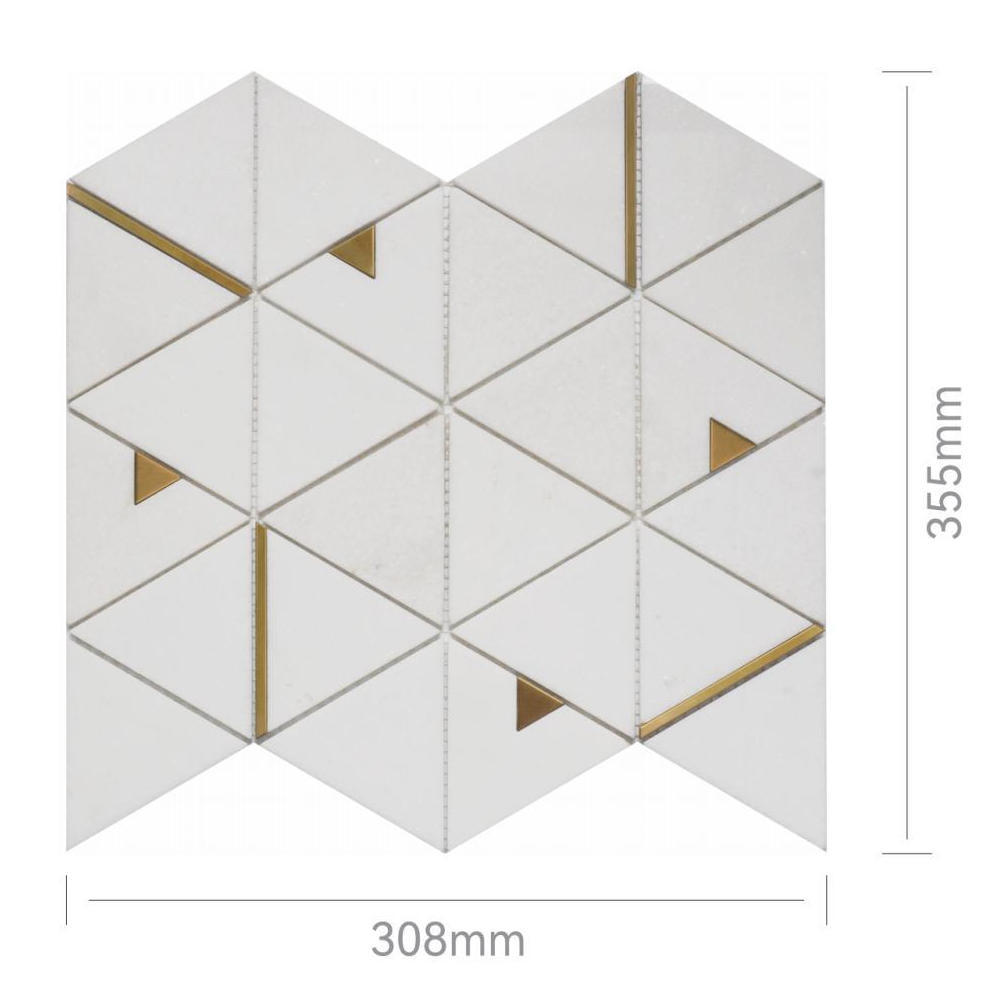
The metal is not an applied trim. The strips sit in the layout as individual pieces on the same backing, so the gold line is part of the sheet from the moment it leaves the crate. What separates it from a plain white marble field is that combination. The white ground keeps the wall quiet and the brass does the talking, which is why this marble brass mosaic tile suits bar fronts, café backsplashes and accent walls where one surface has to carry the room. For anyone ordering at volume, the format does most of the labour: the triangle layout arrives pre-set, joints stay consistent from sheet to sheet, and the pattern repeats predictably across a wall, so a crew is setting sheets rather than individual pieces. As a natural marble mosaic supplier, we work with stone distributors, hospitality contractors and design practices fitting out bars, cafés, bathrooms and reception areas.
Material & Build
- Thassos white ground. The Thassos white marble mosaic is cut from a bright, fine-grained white stone with soft grey veining, and the veining shifts from sheet to sheet because this is quarried natural material rather than a printed pattern. - Gold brass inlay. Polished stainless steel gold brass strips are laid between the triangles as individual pieces in the sheet. The metal arrives in place, so there is no separate trim to mitre, align or fix on site. - 7 mm gauge. Each piece is ground to 7 mm, which gives the sheet a firm body: it stays flat in the carton, beds into adhesive without curling at the corners, and leaves enough joint depth to grout cleanly. - Polished surface. Marble and metal are both polished, so a luxury marble brass inlay tile for accent wall backsplash picks up light and the brass reads as a bright line rather than a flat colour. On a bar front lit from above, or a splashback under a window, that reflection is a large part of what the buyer is paying for. - Mesh-mounted marble mosaic sheet. The pieces are bonded to a flexible mesh backing, so a sheet can be lifted, cut between rows with a blade and set as one unit instead of being pieced together triangle by triangle on a vertical wall.
Light does the rest. Because both materials are polished, the surface responds to whatever lighting the room has. Warm spotlights lift the brass; daylight on a splashback makes the white ground look cleaner and brighter.
Grout decides the drawing. A grout close to the white marble lets the brass line dominate; a darker grout outlines every triangle and pushes the pattern towards something more graphic. Neither is wrong — settle it on a sample panel before the wall is fixed.
The sheet fixes the layout. The triangles and brass pieces are already positioned on the mesh, so the pattern cannot be re-arranged tile by tile. What you control is the setting-out: where the sheets start, how they stack, and where the field stops against a trim or a change of material.
Well-suited as a defined panel. The metal line works hardest when it has edges to stop at — a bar front between two returns, a splashback held by the worktop and the shelf above, a vanity wall inside a niche. Used as a luxury marble brass inlay tile for accent wall backsplash work, it reads as a deliberate panel rather than as wall finish, and the effect survives being close to people.
Production & Quality Control
- Stone selection.
- Cutting. The triangles are cut on a waterjet, which is what gives this design its straight edges and consistent piece size.
- Inlay assembly. Brass strips are cut to length and laid into the pattern with the marble triangles, so the metal line is built into the sheet rather than added on site.
- Grinding and polishing. Assembled sheets are ground to the 7 mm gauge and polished, which is where the surface gloss and the brass reflectivity come from.
- Mesh mounting. The pieces are bonded to the backing in the fixed layout and cured flat, so sheets stack, travel and arrive at site with the pattern intact.
- Inspection and packing. Every sheet is checked for gauge, pattern alignment, chipped corners and polish before it is packed; sheets that fail are reworked or rejected rather than boxed.
- Documentation. If your project file needs measured values — water absorption, hardness, flexural and compressive strength — ask our team for the current test data and the method behind it. As your natural marble mosaic supplier, we would rather send the actual report than an adjective.
Installation
- Check the substrate. The sheet follows the wall, so any hollow or bowed area shows as a shadow across a polished surface. Make the wall flat, dry and dust-free before anything is opened.
- Set out the field. Decide where the pattern starts and stops, mark a level line, and work the layout from the centre of the visible area outwards to the cuts.
- Blend the sheets. Dry-lay sheets from several cartons together before fixing, so natural variation in the marble is spread across the wall rather than concentrated in one corner.
- Use a white adhesive. A white thin-set suited to stone, trowelled to a notch that fills the 7 mm body without adhesive squeezing into the joints — grey adhesive can darken the pale marble at the edges.
- Bed the sheet as one unit. A mesh-mounted marble mosaic sheet is pressed with a grout float or roller across the whole face so every tessera sits in the adhesive; do not lift the mesh off the back.
- Keep the joints consistent. Work sheet to sheet with the same joint width, check the alignment of the brass lines as you go, and clean adhesive off the face before it sets.
- Cut carefully. Cut the mesh between rows with a sharp blade, use a wet saw for straight cuts at the edge of the field, and cut brass pieces with a fine metal blade rather than shears, which distort the strip.
- Grout and finish. Grout once the adhesive has cured, using a grout suited to natural stone and metal, then wipe the brass clean with a dry cloth before the grout residue dries on it.
Care & Maintenance
Marble and polished brass do not want the same treatment, and most of the marking we hear about comes from using one cleaner for both.
Wipe the mesh-mounted marble mosaic sheet with a pH-neutral stone cleaner and a soft cloth, then dry the brass strips with a second, dry cloth instead of letting water stand on them. Acidic products — vinegar, lemon, descalers, most bathroom sprays — dull the polish on marble and will mark the metal over time. Abrasive pads and powdered cleaners scratch a polished surface and are difficult to correct once the damage is done.
In a kitchen or bathroom, seal the Thassos white marble mosaic to the schedule your installer recommends; the sealer is what buys you time on oil, wine and soap spills. Blot a spill rather than wiping it across the sheet, and clean grout lines with a soft brush rather than a scraper.
For a marble brass mosaic tile in a busy commercial space the practical routine is a daily damp wipe and a dry pass over the metal. That is a few minutes of work, and it is the difference between a bar front that still looks new after a year and one that has gone dull.
Applications
- Bar and counter fronts. The most natural home for the sheet: a vertical face at waist height, lit from above, where the brass line catches the light exactly where customers look.
- Café and restaurant backsplashes. The band between the counter and the shelf takes the pattern without dominating the room, and wipes down at the end of service.
- Kitchen backsplash. A luxury marble brass inlay tile for accent wall backsplash runs puts the gold line at eye level between worktop and wall units, without covering the whole wall.
- Bathroom and vanity walls. A single wall behind a basin or a mirror surround is enough; the sheet gives a small room a focal point without a full marble specification.
- Reception desks and lobby features. A wrapped desk front or a lift lobby panel, where the metal reads as a deliberate detail rather than decoration.
- Commercial and display joinery. Back panels and plinths in commercial fit-outs where a premium finish is specified for a compact, well-lit area.
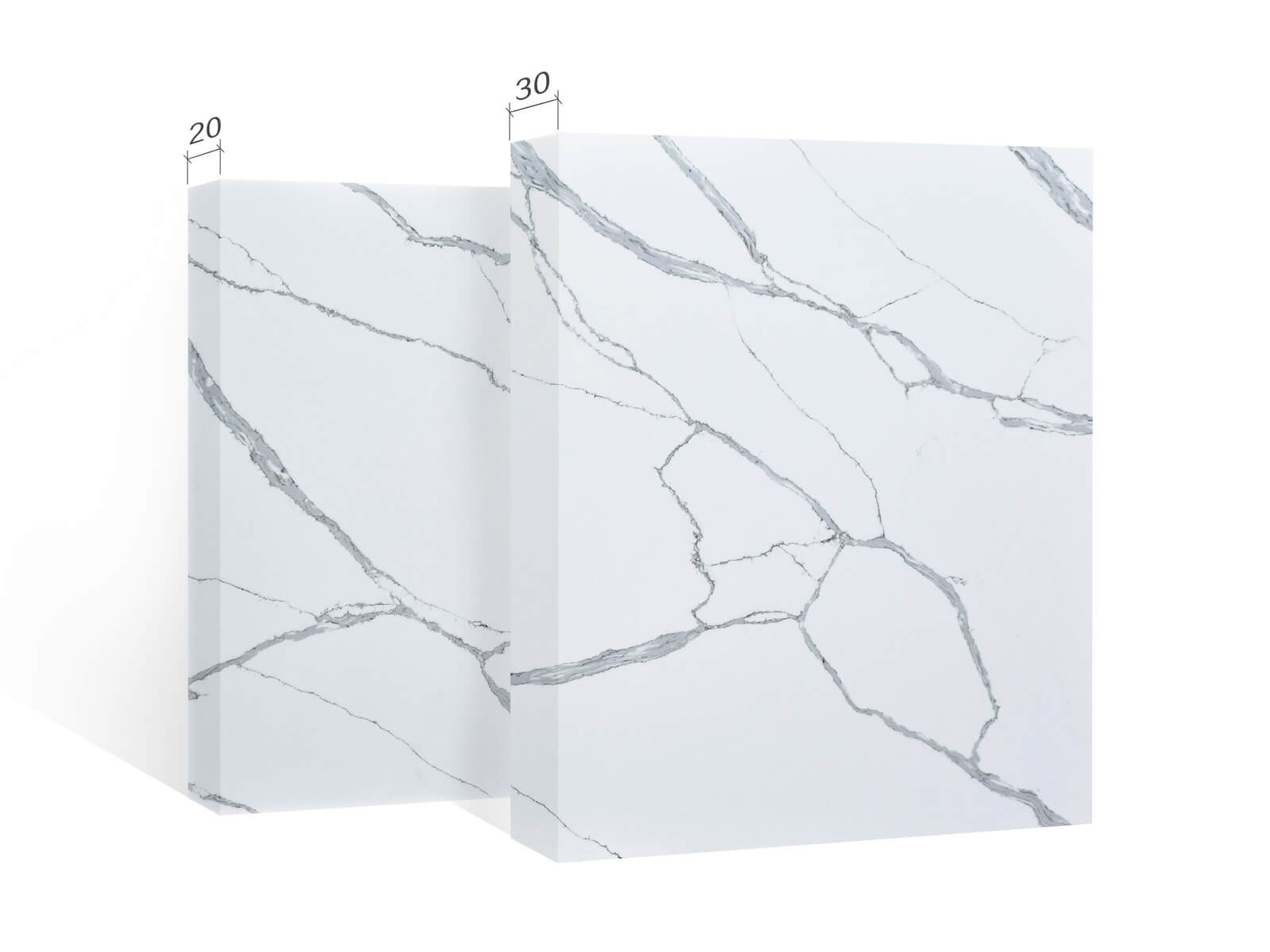
- Alongside our quartz surfaces. If the countertop has to relate to the wall, we also supply engineered quartz in Calacatta Statuario, Calacatta Divine and Calacatta Gold, and our quartz range runs past 100 colours, so the horizontal and vertical surfaces can come from one supplier.
Specifications
| Size | 308*355mm | Material | Thassos white marble with stainless steel gold brass inlay |
| Thickness | 7mm | Net weight | 1.85 kg per sheet |
| Colour | Natural white marble |
| Surface | Polished Finish |
| Mounting | Mesh-Monuted |
| Coverage | Approx. 0.109 m² per sheet, approx. 1.2 m² per carton |
| Packing details | 11 Sheets / Carton, 72 Cartons / Pallet, 20 Pallets / Container |
| Packing weight | 21kg / Carton, 1537kg / Pallet |
| Carton size | 315*370*95mm |
| Product code | MM763 |
Wholesale, Project & Design Partners
We supply this sheet through three channels, and each one needs something different from us. Distributors and wholesalers carry it as part of a stone range and resell to fabricators and showrooms; what they need is a repeatable line that looks the same on the next order. Project contractors fit it into hospitality, commercial and residential packages where the same detail repeats across many rooms; what they need is a delivery sequence that matches the programme. Designers and architects specify it from a sample and a setting-out drawing; what they need is a physical sheet in their hands and a clear answer about how the pattern stacks.
Our buyer relationships run deepest in the United States, Europe and Australia, where American importers, European wholesalers and Australian builders have been buying engineered quartz and natural stone from us for years. The remark we hear most often is about consistency — the same material turning up the same way on the next order. That matters more with a sheet like this than with a plain tile, because a shift in the white shows immediately against the brass.
As a natural marble mosaic supplier our job on a decorative line is to keep the pattern, the gauge and the packing predictable, so a distributor can quote from a price list and a contractor can order a replacement panel without re-approving the look.
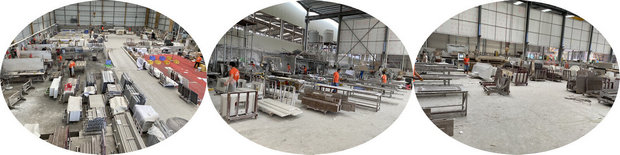
- Four automatic production lines. Our quartz operation runs four automatic slab lines on current-generation machinery, which is what allows a mixed order of mosaic and slab to be planned and moved through the same factory. - An in-house R&D department. A dedicated team develops surfaces and patterns, and it is also where a project question about a layout, a finish or a stone combination gets answered properly. - Experienced production staff. Operators who have run stone production for years, backed by a management team that plans capacity instead of promising it. - A dedicated QC team. Inspection happens against a written standard at each stage of the process, not only on the finished pallet. - OEM and custom service. OEM work and private-label requests are part of what we do; tell us what needs to carry your name, or what a project needs to change, and our team will confirm exactly what is possible for this sheet.
Ordering & Delivery
- Quantity basis. We work in sheets, cartons and pallets. Give us the wall area or the pallet count you need and we will confirm what the order comes to, including a sensible allowance for cuts and for blending. - Pricing. Pricing is factory-direct, and it is at pallet and container volumes that it becomes competitive. Send your destination with the enquiry so freight can be quoted alongside the material. - Lead time. 15–25 days after deposit. It is confirmed in writing with the order rather than assumed from a catalogue. - Samples. Ask your sales contact about sample availability. A physical sheet is the only reliable way to judge the brass tone against your other finishes, and we would rather you approve one than find a mismatch on site. - Project scheduling. If the material is going into a dated project, give us the programme at enquiry stage so production can be planned around it rather than compressed afterwards.
Scale & Supply Capability
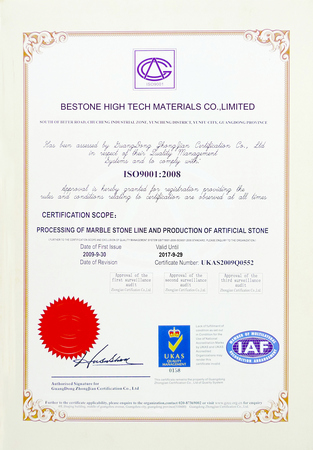
Bestone has been in the stone trade since 2007 and selling through our website to overseas buyers since 2012. Production is in-house, so standard runs and custom or private-label orders are handled by one team rather than passed between suppliers. We serve distributors, fabricators, contractors and designers across North America, Europe, the Middle East, Southeast Asia and Australia, and we confirm each order in writing before production starts. Send our sales team your quantities, destination and target specification, and we will tell you exactly what we can commit to.
FAQ
Is this marble brass mosaic tile natural stone or engineered?
Natural stone. The field is Thassos white marble cut from quarried material, and the gold line is polished stainless steel gold brass set into the sheet. Because the marble is natural, the grey veining differs slightly from sheet to sheet; the brass itself stays consistent.
How much wall does one sheet or one carton cover?
One sheet covers about 0.109 m² at 308 × 355 mm, and 11 sheets to a carton give roughly 1.2 m². Add a margin for edge cuts and for blending sheets across the wall before you convert an area into a carton count.
Can it be used in a bathroom or a shower?
It is made for vertical interior surfaces, so a vanity wall or a kitchen splashback is straightforward provided the marble is sealed and the detail is built properly. For continuous direct water, such as an open shower wall, talk to us and your installer first — marble and polished brass both need more care in a wet environment than they do above a worktop.
What adhesive and grout should the installer use?
A white thin-set adhesive suited to stone, trowelled so it fills the 7 mm body without rising into the joints. Use a grout intended for natural stone and metal, keep the joint width consistent, and clean the brass with a dry cloth before the grout residue dries on it.
How do we cut the sheets around sockets and corners?
Cut the mesh between rows with a sharp blade and set the cut edge against a trim, so the pattern reads to the edge instead of stopping short. Straight cuts at the edge of the field should be made with a wet saw, and brass pieces cut cleanest with a fine metal blade rather than shears.
The sheet is 7 mm — will it sit flush with the surrounding finish?
Check the thickness of the adjacent tile or slab before setting out. At 7 mm the sheet sits close to most wall tile but well under a 20 mm countertop upstand or splashback, so plan a trim, a return or a build-up at the junction rather than finding the step at the edge.
Can the pattern or the sheet size be adapted for a project?
The triangle layout and the 308 × 355 mm sheet are fixed for this design, which is what keeps the pattern repeatable across a wall. If a project needs a different geometry, a second stone or a different proportion of brass, raise it with our team before the specification is locked and we will tell you what can be produced.