Product Overview
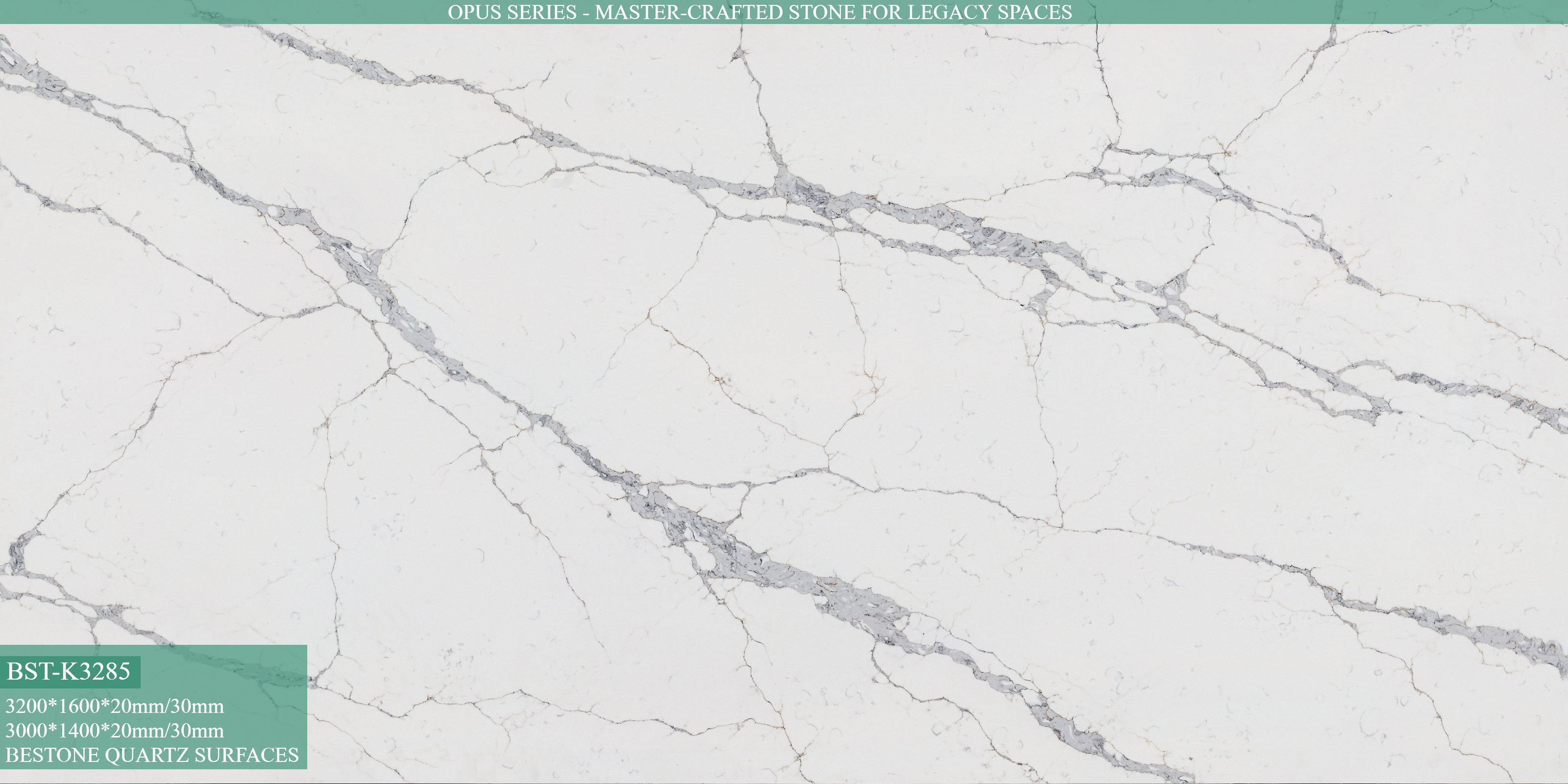
Visually it reads as a Calacatta marble — a bright white field crossed by flowing grey veins — and on the bench it works like engineered stone rather than like natural marble, which is what a fabricator wants to hear. What changes is what the slab is made of. The crystalline silica that conventional engineered quartz is built on is replaced by a high-purity glass and barium-sulfate aggregate system. For a workshop, that takes the material at the centre of the silicosis regulations out of the slab being cut. Distributors add it where a tender names silica; fabricators run it on the same benches as their quartz; contractors and designers specify it where a marble look has to arrive with documentation attached. If your market has already restricted crystalline silica, this is the direct replacement from a crystalline silica free stone supplier, clearing the brief without a design compromise. If it has not yet, this is the version of the product that will still be sellable when it does. The slab is supplied as model BST-K3285 in jumbo and standard formats, in three surface finishes. Ask us about sample availability for the colour you are considering before you commit a container. As global regulations tighten on traditional engineered stone due to silicosis risks, switching to a zero crystalline silica stone for safe interior spaces is no longer optional — it is the future. According to our SGS composition analysis (Report No. 14808-60-7) is not detected in our product, keeping your projects future-proof and your supply chain compliant. - High-purity glass aggregate in place of quartz sand. The bulk of the slab is glass, which brings the density and the polish response normally supplied by crystalline quartz sand, without the respirable crystalline silica. - Barium sulfate for body and whiteness. A dense mineral that gives the slab its weight in the hand and the bright, evenly white background the veining sits on. - Unsaturated polyester resin as the binder. It holds the aggregate together and gives the slab the small amount of flexibility that keeps a thin section from cracking during handling and installation. - Aluminium hydroxide as a mineral filler. Part of the same mineral package, and one of the reasons the material machines cleanly. - No crystalline silica in the mix. Quartz sand is not part of this formulation at all, so the dust a fabricator generates on the saw is not the dust the silicosis regulations are aimed at. - Built to be worked, not handled with care. The slab calibrates, cuts, edges and polishes on standard engineered-stone equipment, so adopting it does not change your cutting programme.
Silica Regulation by Market
Engineered stone has moved from a design decision to a compliance decision. Australia banned the supply and installation of engineered stone containing crystalline silica from 1 July 2024, which means a conventional quartz slab can no longer go into an Australian project at all. In the United States, OSHA and state agencies keep tightening exposure limits, and litigation risk has risen alongside them. The UK and Canada have not banned the material, but both continue to raise workplace dust-control standards, and the direction of travel is one way.
The practical question for a buyer choosing a crystalline silica free stone supplier is not whether that supplier calls the stone silica-free. It is whether the paperwork will survive a tender review. Ours rests on a third-party composition analysis: an SGS report that examines the material and records the characteristic peak of crystalline silicon dioxide as not detected. That is the document you forward to a specifier, attach to a submittal, or hand to a fabricator's safety officer.
We expect the harder follow-up questions too, and would far rather answer them at quotation stage than have a project team find a gap after the slabs are on site.
This is the material to write into a tender that names silica, and the one to put in front of a fabricator who wants to keep cutting engineered stone without rebuilding the workshop around dust extraction.
Production & Quality Control
The slab is made in our own plant on four automatic production lines, with mixing, pressing and polishing all under one roof. Raw materials are inspected and classified on arrival, and nothing goes into the mixer until the batch has been checked. Aggregate, resin, pigment and coupling agents are then combined at a fixed ratio, poured into moulds sized to the slab formats above, and consolidated under vacuum with vibration, heat and pressure in a kiln until the mix has set into a solid slab.
From the kiln the slab goes to a calibrating machine that grinds it to the required thickness, then to water polishing, then to a bridge cutting machine that trims the edges clean. Water is used throughout cutting and polishing — standard practice in any stone plant, and still the right habit here.
Quality control runs the length of that line rather than sitting at the end of it. Our QC team checks incoming material, watches the process parameters and inspects each slab before it is packed; anything that fails on an edge, a face or a dimension is reworked or rejected before it reaches a bundle. The same team signs off pre-shipment inspection, and we welcome scheduled factory visits, third-party inspectors and customer audits.
Behind the line sits an R&D department that develops new colours and works on the formulation itself — it is where the glass and barium-sulfate system came from, and it is why a custom colour is a conversation rather than a special project. Experienced line operators and a production management team run the schedule, which is what keeps a repeat order matching the first one. Because we control the mix ourselves, the formulation is not something you have to take on trust from a third party — the crystalline silica free stone supplier and the plant that makes it are the same company.
Technical Specifications
Every figure in the specification of this zero crystalline silica stone for safe interior spaces is tied to a published method, so a specifier can check what was measured instead of accepting an adjective. Compressive strength follows ASTM C170 and is run dry and again after saturation. The saturated figure is the more useful of the two, because it shows how the slab behaves in a working kitchen rather than on a warehouse rack. Flexural strength follows ASTM C880, the number that matters where a top spans a cabinet run or overhangs a breakfast bar. Water absorption follows ASTM C97, abrasion resistance ASTM C241 for traffic and wear, and impact resistance EN 14617-9, the agglomerated-stone impact method — the closest laboratory equivalent to a pan coming off a hob. Stain resistance is assessed under CSA B45.5 / IAPMO Z124, a plumbing-fixture standard, against a defined set of household reagents. Specular gloss is measured to ASTM D523, so 'polished' becomes a figure rather than a description. Surface hardness is reported on the Mohs scale under EN 15771, the agglomerated-stone method. Two lines in the table are summaries rather than single readings. Water absorption is listed as extremely low with the full result held in the report, and hardness is given as one scale value. If your specification needs the measured figure for the exact colour and thickness you are ordering, ask your sales contact and we will send it with the report.
| Feature | Result | Test Standard |
|---|
| Crystalline silica content | 0% — crystalline SiO2 (CAS 14808-60-7) not detected | SGS FTIR / PGC-MS / EDX / TGA / XRD (Report SZIN2503000555PL01_EN) |
| Glass | 68% | SGS composition analysis |
| Unsaturated polyester resin | 15% | SGS composition analysis |
| Barium sulfate | 12% | SGS composition analysis |
| Aluminum hydroxide | 5% | SGS composition analysis |
| Compressive strength | 240 MPa (Dry) / 233 MPa (Wet) | ASTM C170 |
| Flexural strength | 79.1 MPa (Dry) / 89.7 MPa (Wet) | ASTM C880 |
| Water absorption | Extremely low (see full report) | ASTM C97 |
| Abrasion resistance | 40 | ASTM C241 |
| Impact resistance | > 11.76 J | EN 14617-9 |
| Stain resistance | PASS | CSA B45.5 / IAPMO Z124 |
| Specular gloss | 33 | ASTM D523 |
| Moh's hardness | 3 | EN 15771 |
Design & Appearance
On this zero crystalline silica stone for safe interior spaces, the base is a clean, slightly cool white, and the veining moves across it in broad grey strokes with finer branches — the pattern of a natural Calacatta block, drawn at a scale that suits a whole slab rather than a tile. Across a full slab face the veins carry from one end to the other, which is what lets the material work on an island top or a full-height wall panel where a repeating tile pattern would read as imitation immediately.
Because the pattern is set at slab scale, plan the cut before the blade goes in. Ask for a photograph of the actual slab or bundle reserved for your order and lay your template over it: on a long island you can keep the heaviest vein running the length of the top, and where a joint falls, book-match the two pieces so the veins mirror rather than stop dead. On a vanity or a splashback a quieter section of the same slab often reads better than the boldest one, which means cutting a large slab down does not have to waste the dramatic part — it can be saved for the face everyone sees.
Grey tones are the hardest thing to hold steady across repeat orders. If your project runs in phases, or you are stocking the colour for fabricators, tell us on the first order so production can be planned around it, and ask your sales contact to confirm how that works for the quantities you have in mind.
Formats & Finishes
- Jumbo slab — 3200 x 1600 mm. Sized for kitchen islands, long countertop runs and full-height panels, where one face without a mid-span joint is the whole point.
- Standard slab — 3000 x 1400 mm. The practical format for vanities, splashbacks, table tops and smaller fabrication runs, and the easier size to move through a compact shop.
- 20 mm thickness. The default for residential and most commercial worktops, and the thickness that keeps a jumbo slab within what a small crew expects to handle.
- 30 mm thickness. For a heavier built-up edge, high-wear commercial tops and details where the slab edge is meant to read as a solid band.
- Polished. A high-gloss face that gives the veining its depth and reflects a room back at you; the usual choice for a statement island.
- Matte (honed). A soft, low-reflectance surface that hides fine marks and suits quiet, contemporary schemes.
- Leather. A textured, tactile finish that breaks up reflection, adds warmth and is forgiving of fingerprints in busy contract interiors.
- Sign off against a physical sample. Finish and colour should always be approved on a piece of the actual batch, never on a screen image.
Fabrication & Installation
- Inspect on arrival. Slabs travel and are stored upright in the A-frame; check the bundle, the foam and the batch reference against your order before the frame is broken down.
- Template the job. Include every cut-out, and mark the intended vein direction and the position of any joint on the template so the shop cuts to the drawing rather than to whatever fits the offcut.
- Cut. A bridge saw or CNC with diamond tooling, run with water suppression as normal practice for engineered stone.
- Cut out sinks and hobs. CNC cutting gives accurate dimensions and a clean opening; check the radius against the appliance template before the tool goes in.
- Profile and polish the edges. Automatic polishers take edges to at least 3,000 grit as standard, and some projects call for 5,000 grit or higher — agree the profile and the sheen on a sample piece first.
- Dry-assemble. Trial-fit the tops and check the seams, the cut-outs and the overhangs before anything is bonded.
- Install and joint. Set the tops with a colour-matched adhesive and confirm the adhesive recommendation for your chosen finish with our team before you start.
- - Slabs travel in strong export wooden bundles or frames, with foam between the sheets so faces cannot rub against each other on the road or at sea. - Cut-to-size tops go into fumigated wooden crates, with edge protection on the profiled edges and the cut-outs blocked so nothing shifts in transit. - Upright, never flat. Slabs are loaded and stored on edge in the A-frame; a slab laid flat and then walked on is where most breakages begin. - Packed for the container, not just the pallet. Loading plans are built to use the container space properly; if your site needs a particular offloading sequence, say so when you order. - Checked before it leaves. Pre-shipment inspection covers the face, the edges and the packing, and the loading is photographed so there is a record of how the bundle left us. - Inspect before you sign. On arrival, check crates and bundles for impact damage and photograph anything that looks wrong before unloading — that record is what a claim is built on.
Applications
- Kitchen islands and countertops. The format where the pattern matters most: a jumbo slab takes a long island top in one piece, so the vein runs uninterrupted instead of restarting at a joint.
- Bathroom vanities and splashbacks. A quieter cut from the same slab, worked to a 20 mm edge, with a white base that sits comfortably beside white sanitaryware and brushed metal.
- Hotel lobbies and reception desks. High-visibility, high-touch surfaces that still have to look the same after a year of use — the gloss and stain results in the specification are what this application leans on.
- Restaurant and bar tables. Heavy traffic, spilled wine and coffee, and a top that is wiped down several times a day.
- Hospital and school wall cladding. Interiors where indoor air quality is written into the brief, and where the client's safety team signs off the materials schedule before work starts.
- Flooring. Laid in the same material as the tops so a scheme reads as one stone rather than three.
- Distributor stock and fabricator showrooms. A compliant colour to put in front of trade buyers who are already being asked for silica declarations.
- Engineered stone does not need the periodic sealing that natural stone does, and this silica-free quartz surface is no exception: there is no sealer to reapply and no penetration schedule to keep. For daily cleaning, use a soft cloth with mild soap and water, then dry the face; wipe wine, coffee, oil and citrus promptly instead of leaving them to sit overnight. Abrasive pads, scouring powders and aggressive solvents can dull a polished surface, so test any unfamiliar cleaner on an offcut before using it on a visible top. Cutting directly on the surface is the most common way a worktop picks up scratches — use a board — and put a trivet under hot pans, because the resin binder is more vulnerable to thermal shock than the mineral aggregate. Normal wet use around a kitchen sink or bathroom basin is fine, but wipe up standing water and do not let it sit under a dish rack or around a tap base for long periods. This is an interior material: keep it out of direct sunlight and away from exterior walls, facades and semi-outdoor kitchens, where UV exposure and repeated heating and cooling can warp a slab and fade the colour. If a project genuinely needs an exterior or continuously wet surface, tell us at enquiry stage and we will point you to a natural marble panel or another product in the range instead of forcing this one into the wrong detail. Store slabs upright in the A-frame, never flat on the floor, and support overhangs during fabrication and installation.
Ordering & Delivery
- Send the specification. Colour, format, thickness, finish, quantity and destination port.
- Say what the project needs in writing. A composition report for a submittal, third-party inspection, or a private-label programme — tell us at enquiry stage so it is built into the schedule.
- Get the quotation. It is built from the format, thickness, finish and quantity you have asked for, priced from our own factory rather than through a trading layer.
- Confirm the order. Specification, packing and delivery terms are confirmed in writing before production starts, and that confirmation is the document we both work from.
- Production and lead time. Standard lead time is 15–25 days after deposit; if you are ordering against a fixed installation date, tell us at enquiry stage so the schedule can be checked against it.
- Private label and OEM. We print your logo or company name on the back of each slab, and customised labelling or lot numbers are available; customer confidentiality applies.
- Warranty. Warranty terms and what they cover are set out for your order — ask your sales contact to confirm them in writing with the quotation.
- Loading and delivery. Slabs ship by ocean freight to major ports worldwide, with the loading plan built around the container.
- Water absorption is recorded in the specification as extremely low. The test measures how much water a specimen takes up by mass; the measured percentage is held in the full report for your batch, and we will send the figure that matches the colour on your order rather than apply one number across the range.
- In use, a low absorption result is what gives you time to wipe up wine, oil, coffee and citrus before they mark the face: the surface is non-porous, so a spill sits on it rather than soaking in.
- Surface hardness is reported as 3 on the Moh's scale. Treat that as a measured value with a practical meaning: the face resists ordinary wear but is softer than crystalline quartz, so cutting boards and trivets still belong on the bench.
- Abrasion resistance is 40. That is the figure to quote for a reception desk, restaurant table or other commercial top that is wiped and slid over every day, rather than for a low-traffic vanity.
- Warranty length and coverage are confirmed in writing with your quotation. Ask for the warranty document at enquiry stage and check the term, whether cover is material-only, and whether fabrication, installation, heat damage or exterior use are excluded.
- Keep the batch reference from the bundle label, the delivery paperwork and an offcut from the same batch. If a claim is ever needed, photographs of the affected area plus those references let us assess it without guessing which production run the slab came from.
- For a project submittal, ask for the absorption result, the hardness value and the warranty letter as one package. Sending them together saves the specifier from asking for each document separately.
Scale & Supply Capability
Bestone has been in the stone trade since 2007 and selling through our website to overseas buyers since 2012. Production is in-house, so standard runs and custom or private-label orders are handled by one team rather than passed between suppliers. We serve distributors, fabricators, contractors and designers across North America, Europe, the Middle East, Southeast Asia and Australia, and we confirm each order in writing before production starts. Send our sales team your quantities, destination and target specification, and we will tell you exactly what we can commit to.
FAQ
Is the stone completely free of crystalline silica?
Yes. The specification records crystalline silica as not detected, with the full breakdown alongside it. The distinction that matters is crystalline versus amorphous: the aggregate is a high-purity glass rather than quartz sand, and it is the crystalline form of silica that the regulations and the test are aimed at. Nothing in the formulation introduces it.
How does the strength compare with normal quartz?
The compressive result in the specification was measured to ASTM C170 in both dry and saturated conditions, and it sits above many natural stones and alongside top-tier engineered quartz — which is why this material is specified for commercial tops and not only for residential work. The saturated test was run deliberately: a worktop spends part of its life wet, and the flexural result after saturation comes out no lower than the dry one, so the slab is not softening in service.
Does the surface need sealing?
No. There is no sealer to apply at installation and nothing to reapply later, which the absorption and stain-resistance results in the specification bear out. Wipe spills rather than leaving them overnight, and keep abrasive pads off a polished face.
Can it be used outdoors or in direct sun?
No — this is an interior product. Engineered stone contains resin, and prolonged direct sunlight can warp a slab and fade the colour, while thermal shock is hard on the surface as well. Keep it inside for tops, vanities and wall cladding; if you are working on an exterior or semi-exterior detail, tell us and we will point you to the right material in the range.
Do you have a track record with large projects?
Yes. Nineteen years in the industry, with materials supplied into international hotels, condominiums and apartment complexes — work where the colour has to hold across phases and the packing has to survive a site with no covered storage. We are used to being asked for the documentation a project team needs before the first slab ships; send your drawing package and programme with the enquiry and we will quote against it directly.
What should I check before specifying it for a regulated project?
Ask for the composition report itself rather than a summary. Check the report reference and its date, the detection limit that applies, and which colours and thicknesses the current report covers, because a submittal usually stands or falls on exactly those three points. Specifiers increasingly want the document attached to the specification, and answering it once at quotation stage is easier than answering it three times during a tender.