Product Overview
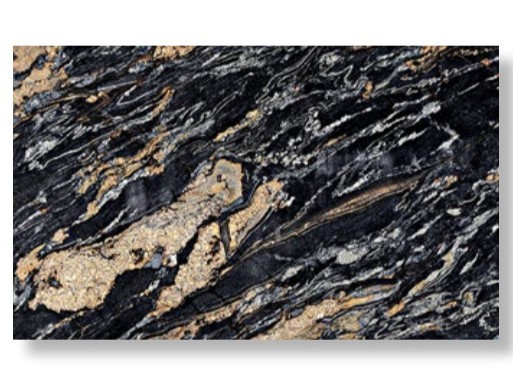
A Thunder Black thin marble slab begins as a solid block of natural marble. What the sheet shows is a deep black ground crossed by gold and beige mineral veining that runs in long, wavy bands — a pattern drawn by the stone itself, which is why no two panels repeat exactly. Because so little stone remains in the sheet, it takes up barely any depth in a wall build-up, and on a refurbishment the existing finish usually stays in place with the marble laid straight over it, which takes a strip-out out of the programme. The colour is worth thinking about before anyone commits to it. Black absorbs light, so in a bright lobby the wall reads almost as a single dark plane and the gold veining only catches the eye where light rakes across it. In a dim corridor the same panel goes quiet and close to matte. For flexible marble slab wholesale orders, approve a piece under the lighting you plan to use, or approve from a sample held against the actual wall, rather than from a screen.
Production Process
- Material inspection. Incoming marble blocks, quartz aggregate, sand and powder are graded and classified before they reach a machine, and anything that will not hold the required face is rejected at the gate.
- Feeding and mixing. On our four automatic quartz slab production lines — the newest machinery in the plant — graded quartz aggregate is blended with unsaturated polymer resin, pigment and coupling agent at a set ratio and leaves the mixer as one uniform body.
- Forming. The quartz mix is compacted under vacuum, vibration, heat and pressure into slabs of 3050 × 1450 mm or 3250 × 1650 mm. Thunder Black marble veneer takes the other route: the block is sawn, sliced down to the thin sheet and flattened, with no resin body involved at any stage.
- Grinding and polishing. Quartz slabs are calibrated to the required thickness and water-polished; marble sheets are ground and polished on the same principle until the face is flat and the veining reads cleanly from one end of the panel to the other.
- Edge cutting. Rugged edges are squared on a bridge cutting machine by operators who have cut stone for years, so panels arrive with a clean edge line and the joints close tightly on site. 6.
Test Data & Documentation
| Water absorption | Result for the colour supplied, together with the test method used |
| Mohs hardness | Surface hardness result, with the method behind it |
| Flexural strength | Result, with the standard the test follows |
| Compressive strength | Result, with the standard the test follows |
| Report reference | Quoted on the report together with the test date |
| Third-party testing | Arranged on request against your project specification |
| Factory audit | Scheduled visits and pre-shipment inspection welcome |
Trade Buyer Feedback
Buyers judge a stone supplier on the second order more than the first. Importers tell us that consistency matters more than anything printed in a brochure: the container that lands in March should look like the one that landed in September, and the paperwork should be complete when it arrives. Wholesalers in Europe who supply construction firms value having engineered quartz and natural marble under one supplier, so a project can be specified in one conversation instead of three. Builders fitting a black thin marble wall panel for hotel lobby decoration tend to talk about the fitting instead — panels cut to the schedule, joints that close, and a wall that is finished when the programme says it will be.
Installation & Fixing
- Check the substrate before anything else. A black thin marble wall panel for hotel lobby decoration is only as good as the wall behind it, so that wall has to be sound, dry and continuously supported — plasterboard, cement board, joinery board, or existing tiling that is well bonded and flat. The veneer telegraphs a hollow or a proud screw head, so fill and sand the surface first and re-fix any board that moves under hand pressure.
- Set the wall out from the panel schedule. Mark the joint lines and the centre line on the substrate, then dry-lay the numbered panels in the order they were packed. Where a cut edge lands decides how the whole elevation reads, so move the setting-out now, while the wall is still bare.
- Choose the adhesive for the build-up rather than from habit. An adhesive with some give, compatible with natural stone, spread across the full back of the panel — a contact adhesive or a cement-based adhesive that its manufacturer recommends for thin stone — gives the sheet even support. Spot-bonding, PVA and hard, rigid adhesives leave voids that a sheet this thin cannot bridge.
- Press and roll each panel into place. Work from the centre line outward, press the sheet down across its whole face with a roller or a flat trowel, and run a straightedge over it while the adhesive is still open. A high spot that feels like nothing under the hand will show in raking light once the wall is finished.
- Treat curves as their own detail. Wrap columns and curved reception fronts dry first to see how the sheet wants to sit, then fix from the middle of the radius outward so surplus length is pushed to the two edges and trimmed there. Send us the radius and the substrate, and we will confirm how we would detail it.
- Protect the face as you go. Tape the polished face rather than the joint, keep mortar and adhesive off the surface, and wipe any residue before it cures — once set, it comes away with a blade and takes the polish with it.
- Agree who signs off what. We will detail the fixing we would use for the build-up and radius you send, and we will say where we think the detail needs a movement joint or a mechanical trim at an edge. The final choice of adhesive, the substrate preparation and the site conditions rest with your installer, who can see and touch the wall; nothing on this product replaces that inspection.
- For flexible marble slab wholesale deliveries, check the crate against the panel schedule on arrival. Photograph any damaged face, keep the damaged panel aside and report it before the sheet goes on the wall — a claim is far easier to settle before fixing than after.
Moisture & Surface Care
On a hotel lobby wall the figure is a specification detail; in a bathroom, a splash zone or any area that stays wet, it is the first thing to settle before the order is placed. Sealing the Face Seal the face before fixing and seal again once the joints are finished, using a penetrating stone sealer from a reputable maker and following its stated recoat interval. On a busy reception or bar wall, treat re-sealing as part of the maintenance cycle rather than a single event at handover. Daily Cleaning Use a neutral pH stone cleaner and water with a soft cloth. Blot spills — coffee, wine, oil, citrus — rather than wiping them into the joint, because the longer a coloured liquid sits, the deeper it travels. Never use an acidic descaler, vinegar, bleach or scouring powder on the polished face; they dull the polish and open the surface. In daily use, felt pads under furniture, mats at the doors and a board instead of a knife do most of the work. The sheet is a facing, not a structural top: hot pans and direct chopping belong on a trivet or a board, even where an ultra thin marble sheet is used to resurface a counter. Storage Before Fitting Keep panels flat on a level pallet, face up, off the ground and under cover. Do not stand them on edge against a wall for days and do not stack anything on the face — a thin sheet that has taken a set is difficult to flatten again, and a warp shows at every joint. Common Mistakes Sealing over a damp panel, leaving adhesive residue to cure, cleaning with a kitchen descaler, and bonding onto a painted or dusty wall that was never keyed. Each one is low-cost to avoid at the time and expensive to correct once the wall is finished.
Hotel Interiors & Surfaces
- Lobby feature walls. When the brief calls for a black thin marble wall panel for hotel lobby decoration, the elevation is set out panel by panel and the veining is planned across the whole wall before a single cut is made, so the wall reads as one surface rather than a grid.
- Reception desk fronts. The visitor-facing side of a reception counter is usually curved and is the surface guests stand closest to. The sheet wraps the radius without a moulded or laminated section, and the knocks it takes are the ones a stone face is good at.
- Lift lobbies and lift cars. A cabin has a fixed wall build-up and very little room to give; a sheet that adds almost no depth can be fixed inside the car and travels up with it afterwards.
- Bar and back-bar elevations. Dark stone behind a back bar holds the gold veining under warm light and carries a long, uninterrupted face behind shelving and bottles.
- Corridors and lift walls. Long runs are set out on a panel schedule so joints land at door reveals and corners instead of in the middle of a sightline.
- Ceilings and soffits. Surfaces that could never carry a stone slab take the sheet on a light frame, which is where the low weight does most of its work.
- Joinery and furniture. Cabinet door faces, wardrobe fronts, headboard walls, table tops and curved furniture are faced or wrapped in the same material as the wall, keeping one stone across a suite.
- Countertop remoulding. An existing top that is sound but tired can be resurfaced in place instead of being stripped out and replaced.
Specifications
| Material | Natural marble, cut from solid blocks |
| Thickness | 1–3 mm |
| Colour | Black ground with gold and beige veining |
| Veining | Long, wavy bands; density varies from panel to panel |
| Surface | Polished |
| Form | Thin marble veneer panel, supplied flat |
| Weight | A fraction of solid stone of the same area |
| Flexibility | Follows curved and slightly uneven substrates |
| Application | Interior wall cladding and faced surfaces |
| Edges | Squared and finished to suit the joint detail |
Custom Shapes & Private Label
- Send the layout. Share elevations, a marked-up drawing or photographs of the space, and say which surfaces are flat and which curve.
- Agree the panel schedule. We come back with panel sizes, joint positions and a cutting plan, so the veining runs the way the design intends instead of breaking at every joint.
- Cut to shape. Panels are cut to the agreed sizes and shaped around openings, curves and special edges — the sheet can be taken to almost any outline your drawing calls for.
- R&D and pattern work. Our R&D department handles new outlines, fixing details and finish trials, and the same team develops colour and pattern for the engineered quartz range, which runs to more than 100 colours with custom pattern work available.
- Private label. We produce under our customers' own brand, with labels, packing and documentation set up to your requirements — which is how many wholesale programmes begin.
Ordering & Delivery
- Panel schedule first. We quote against a schedule of panel sizes rather than a square-metre figure alone, so you can see how the wall is cut and where the waste falls before anything is agreed.
- Pricing. Factory-direct pricing is quoted against that schedule, so the figure reflects the panels your elevation actually needs rather than an average rate.
- Lead time. Production is scheduled at 15–25 days after deposit, and the date is confirmed in writing once the panel schedule is signed off.
- Packing. Panels are crated with the polished face protected, and the crate plan and loading arrangement are agreed with your forwarder before shipment.
- Shipping and payment terms. Confirmed with your quotation, so the landed cost is clear before production starts.
- Samples. Ask your sales contact about sample availability for the Thunder Black thin marble slab, and about photographs of the current bundle before you commit.
- Repeat programmes. Distributors and importers order on a flexible marble slab wholesale basis, with repeat runs scheduled against their own stock plan.
Scale & Supply Capability
Bestone has been in the stone trade since 2007 and selling through our website to overseas buyers since 2012. Production is in-house, so standard runs and custom or private-label orders are handled by one team rather than passed between suppliers. We serve distributors, fabricators, contractors and designers across North America, Europe, the Middle East, Southeast Asia and Australia, and we confirm each order in writing before production starts. Send our sales team your quantities, destination and target specification, and we will tell you exactly what we can commit to.
FAQ
How thick is the Thunder Black thin marble slab, and how does it compare with a solid slab?
The sheet is a thin veneer, against the 20 mm or 30 mm of a conventional stone slab. Most of the weight and nearly all of the wall depth go with the thinness, and the panel can be laid around a curved or slightly uneven substrate instead of demanding a perfectly flat one. It is a facing, though, not a structural slab: the wall, joinery or frame behind it carries the load.
Can panels be cut and shaped on site for sockets, openings and curves?
Yes. Ultra thin marble of this kind is thin enough to be cut and trimmed by a fabricator or a careful site team, and it can be taken to almost any outline the drawing calls for. Agree the cutting plan with us before work starts, because where the cuts fall decides how the veining reads across the wall, and off-cuts from one panel often cover a return or a small detail nearby.
How should joints and veining be planned across a whole lobby wall?
Work from a panel schedule, not a square-metre order. Set the joints out first so they land at reveals, corners and door frames, then decide how the veining should run: horizontally along a long elevation, book-matched either side of a centre line, or wrapped continuously around a column. When the elevation is a hotel lobby wall, this lay-out is what decides whether it reads as one surface or as a grid of tiles. Panels are cut to that plan, numbered and packed in sequence, so they go up in the order they were designed.
How much variation should I expect between panels?
Every panel is real stone, so vein density and the warmth of the gold shift from block to block. Two ultra thin marble panels cut from the same block sit together convincingly; mixing blocks on one wall is visible, especially in raking light. Approve from photographs of the actual bundle, or from a sample, before the order goes into production.
What substrate and fixing should we plan for?
The panel is a facing, so the substrate carries it: sound plasterboard, cement board, joinery board, or an existing finish that is well bonded and flat. A marble veneer this thin will follow a slight bow that a rigid slab would not, but it still needs continuous support behind it. Send us the build-up you intend to use and we will tell you how we would detail it; the final adhesive and fixing choice rests with your installer and your site conditions.
What test data can you send before we write the specification?
Ask for the water absorption result and the method used, the Mohs hardness figure, and the flexural and compressive strength values with the standard each test follows. We report these for the colour and batch you are ordering rather than as a generic sheet, so the numbers that go into a tender match the material that arrives. Third-party testing and a pre-shipment inspection can be arranged against your specification.